
Lots of people consume diet sodas these days and feel that they’re doing the right thing for their body by doing so. After all, there’s no nasty high-calorie sugar or high fructose corn syrup to cause weight gain, so how can it be bad? Without going into all the potential hazards of consuming aspartame or sucralose (the two most common man-made artificial sweeteners used in diet soft drinks), I’d like to cover a few aspects of what diet sodas can do to our bodies.
WEIGHT GAIN FROM DIET SODA?
The following information comes from a 2018 article from Prevention.com.
While diet soda has been linked to obesity in the past, a new study focused on where daily drinkers gained extra fat: in widening waistlines. Researchers also suggest a range of possible reasons for how diet sodas might increase risk, beyond just increasing hunger hormones (the most commonly held assumption).
To reach their conclusion, researchers measured diet soda intake, waist circumference, height, and weight of 466 adults at study onset and at three follow-ups. The result: the increase in waist circumference among daily diet soda drinkers was more than triple that of non-drinkers. Why that’s so scary: greater belly fat has been linked to a greater risk of metabolic syndrome—a combo of risk factors that may lead to high blood pressure, diabetes, heart disease, and stroke.
There are a few potential reasons diet soda could pack on belly fat, researchers say, including the sodas’ acidity from the phosphoric acid used in both regular and diet soda to lend a tangy flavor and act as a preservative. “Constantly ingesting this might create an even more acidic environment in your gut than normal, which may affect biodiversity and allow some harmful strains of bacteria to thrive,” says lead study author Sharon Fowler. A large French study found an increased risk of diabetes in diet soda drinkers, and among people with more acid-forming diets.
Artificial sweeteners also may play a big role, and there are a few ways in which they may exert their negative effects, says Fowler. First, artificial sweeteners may cause changes to gut bacteria, leading to the overgrowth of strains that are more efficient at getting every last calorie out of the food you eat. Second, they may mess with our ability to metabolize glucose, which can lead to insulin resistance, which in turn increases hunger. And third, there’s some speculation that they mess with us neurologically, interfering with our body’s signals to quit eating.
Because the belly-expanding effects of these drinks were found at such low levels—just one diet soda drink per day—it may be best to ditch the habit altogether. If you still crave that refreshing fizz, try transitioning to something like a zero-calorie seltzer (there are even naturally flavored caffeinated varieties) or naturally effervescent kombucha tea.
This image highlights some other things that diet drinks can do to our bodies.
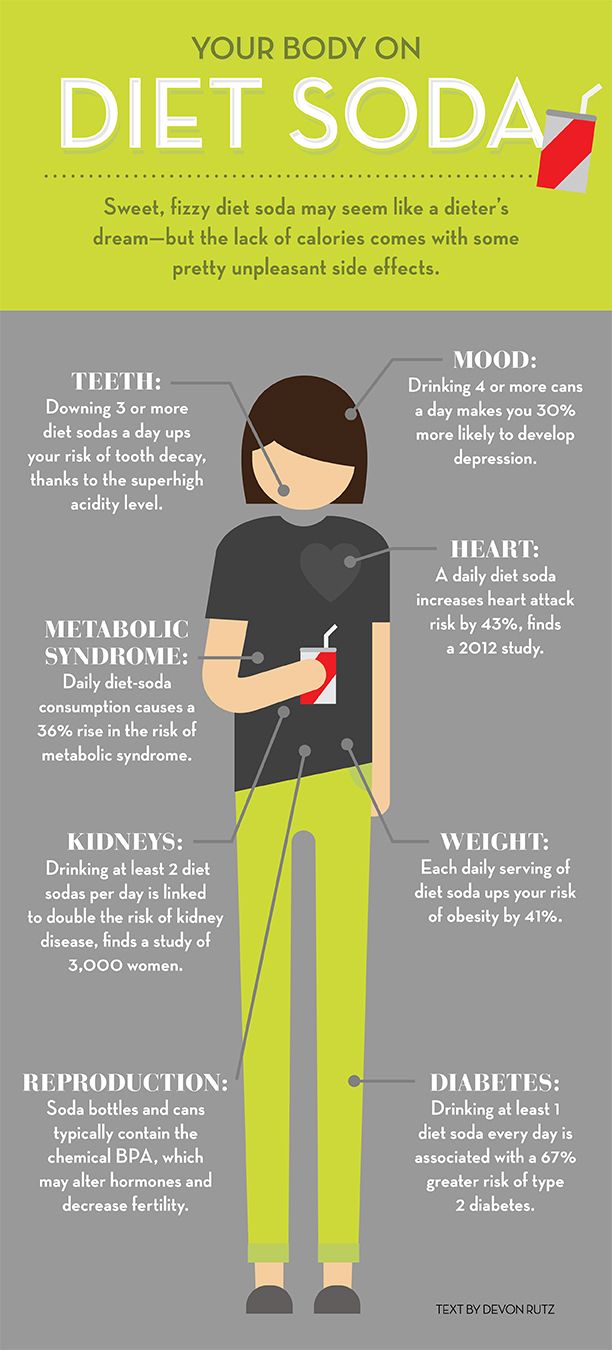
And here are even more health concerns connected with diet soda consumption, that I learned from Inc.com.
1. It makes our bodies produce insulin.
Insulin, secreted by the pancreas, is how the human body stores sugar. When the taste of artificial sweeteners (in soda, yogurt, or anything else) hits your brain, it automatically sends a signal to your pancreas to begin producing insulin. Insulin is what tells our cells to either use sugar as food or store it as fat–without it, our bodies can’t process the sugar that lands in our bloodstreams. When your pancreas produces insulin to deal with anticipated sugar, but then no sugar arrives, it confuses your body and disrupts its metabolic process. This may explain why several studies have shown a link between regularly drinking diet soda and metabolic syndrome, a collection of symptoms that includes larger waist circumference, higher blood pressure, and higher blood sugar.
2. It conditions our taste buds for sweetness.
You probably know or have observed that the more regularly you taste something (sweetness, saltiness, etc.) the more inured to it you become. This is why people who stop eating sugar or salt suddenly find many commercially available foods extremely salty (potato chips, for instance) or extremely sweet (candy bars).
So it’s worth considering that artificial sweeteners are dramatically sweeter than sugar, and although it may not register that way on your tongue, diet soda is in fact much sweeter than regular soda. All that sweetness accompanied by zero calories confuses your brain as well as your metabolic processes, and tends to leave you craving sugar more than before.
3. It makes you feel entitled to eat more.
Counting calories is still the most common method people use to try to lose weight, and it’s the basic principle behind both Weight Watchers and the popular weight-loss app Lose It! If you’re counting calories, there’s a simple equation: Drinking a regular soda means you have to eat 140 calories less of something else that day or that meal. Drinking a diet soda means you’ve consumed zero calories, so you get a free pass to eat more. But since drinking the diet soda has fooled your body into expecting sugar, it’s changed the way you metabolize those other calories–you may store more of them as fat and use fewer of them as energy–which could leave you hungry and wanting even more food.
If all of the above isn’t enough to make you avoid the stuff, then consider that other studies also show drinking diet soda is associated with increased risk of stroke and Alzheimer’s disease. (Drinking regular soda seems to be bad for the brain as well.)
I don’t know about you, but I’m sticking to water, unflavored seltzer, coffee, tea, and the occasional beer or red wine. Soda, both regular and even diet, can be sweet, bubbly, and yummy. But it just isn’t worth the risk.
Here’s a video that shows six health risks that can come from drinking diet sodas.
I’ve never cared for diet soft drinks, but I did drink low-calorie (artificially sweetened) fizzy fruit drinks for a time, until I learned about the possible health risks of ingesting the chemical sweeteners they use. Now I only drink bottled water, sparkling water, V8 and diluted fruit juice. Honestly, since going Whole Food Plant-Based even straight apple, grape or orange juice is much too sweet for my taste buds. I dilute it 50/50 with water and it tastes just right to me.
In the last part of today’s post I share eight benefits of giving up diet sodas. For more details of each benefit, read the full article on Prevention.com.
1. Your mind seems sharper and migraines go away.
2. Food tastes better.
3. It helps with weight loss.
4. Bones become stronger.
5. Your attitude towards food changes.
6. あなたは酒をよく扱う. (you’ll need to read the full article here to find out what #6 is. Being a teetotaler I don’t view it as a benefit for myself.)
7. Risk for diabetes and fat storage goes down.
8. Your kidneys function better.